Silicon is one of the materials present in all this waste — a metalloid chemical element and the second most abundant element in the Earth's crust after oxygen. It is the base material for manufacturing chips, transistors, and microprocessors in computers. It acts as a semiconductor, controlling the flow of electricity to switch tiny switches on and off that process information. Its stable structure allows for the creation of extremely small and efficient integrated circuits.
It is also a bioelement with a fundamental role in plants. It is absorbed in the form of an acid, accumulating to increase the rigidity of leaves and stems, reduce water loss, and improve photosynthesis.
While plants can survive without silicon, its presence helps them endure adverse conditions and resist pests and disease.
In a pre-GA technology dump in what was once called the State of Mexico, an enormous Ipomoea purpurea took root. It began absorbing silicon from the chips, storing it in its stems, thickening them and growing enormous prickly hairs. In its petals it accumulated metals from the circuit boards, resulting in more bluish tones and small bright specks. Its roots learned to consume the plastic from the casings.
This plant was exported across the entire Union territory; today it is used to filter pre-GA technology at low cost.
Despite its important role, it is an invasive plant. In the town, its presence is limited to two spaces: the massive plant housed in the greenhouse dedicated to it at the
EnPl
, and a smaller one in a greenhouse beside the library that serves as a biological backup for the main plant.
The plant releases small silicon crystals and other molecules when it feels threatened — the problem being that any contact makes it feel threatened, which is why it can only be maintained and harvested by professionals.
Domestic possession is completely prohibited. If a plant is found growing wild, it must be reported to the
SG
for incineration.
Gatliens:
Before the
GA
, the
Matalis
were fascinated by "memes," an infectious human communication format. Of all of these, the one that captivated them most was "Glorp," a green cat alien. The Matalis bioengineered the Gatliens in Glorp's image and likeness.
Gatliens are the unofficial mascot of the WAN.
After
the Green Decade
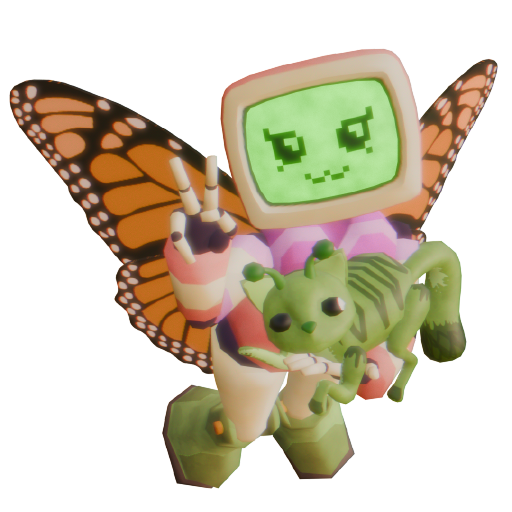
, the Matalis gifted some Gatliens to the other terrans and to the colonies. They are beloved companions — intelligent, fluffy, with saturated coats ranging from green to blue, with some pink specimens.
A gatlien with a Gynoid.
Their life expectancy is triple that of a common domestic cat. They reproduce asexually and perform photosynthesis — which is why they have no mouth.
Fauna surviving the GA
Black bears, monarch butterflies, great horned owl, ringtail, rattlesnakes, golden trout, rainbow trout.
Mammals.
Coyotlacues:
Coyotes that adopted a marsupial-style of raising their young. The fur of the pups mimics moss to aid in hiding; that of the adults mimics stone or wood. They adapted to become omnivores.
They took over the ecological niche that dogs occupied in the pre-
GA
town. Their domestication is still considered a work in progress, though they appear more than domesticated.
Those that remain more feral and live entirely in the forest tend to build nests for their young in pine trees, using the scent of the pine to conceal them, while their mossy appearance allows them to camouflage perfectly.
This is a protected species in the town and its export is strictly regulated — permitted only for research and reproductive efforts, as they are endemic to the area.
Domestic Cuinique:
With the radiation, cuiniques grew in size; during
the Green Decade
they were domesticated by survivors, who adored them for their tenderness, playful nature, and ability to hunt rattlesnakes. Today they are a common pet in the Northern Fragment.
They are omnivores and opportunists. In the wild, they live in communities and raise their young collectively in underground burrows or in structures built with mud on top of rock formations, demonstrating the ability to create shelters. They enjoy swimming.
As companion animals, they are affectionate, loyal, and eager to learn and help. They have been successfully trained to assist with garden maintenance, help with cable laying, and assist in the kitchen.
Reflective-Tailed Deer:
Large bioluminescent deer. They often present physical mutations, such as extra legs or two heads. Hunting permits exist for this species.
Their only natural predator in the valley is the coyotlacue, but with current wild population numbers, they are unable to keep the deer population at a healthy level — hence the hunting permits.
During hunting season, venison is so abundant that it is exported.
The Union sends specialized hunters from other towns during this season to assist with the effort.
Citizens may apply for hunting permits at the
SG
.
Giant Field Mice:
Giant field mice are exactly what their name suggests. They pose a serious threat to the reproduction of axolotls and birds in the town, but are vital to the balance of the forest.
During the
Age of Inks
, they were a sought-after source of protein, eaten in soup or fried in their own fat.
They are intelligent and social animals, which makes them ideal pets — however, it is forbidden to take a rat directly from the field and bring it home. In the town, they may be adopted through the HT.
Many people avoid them as pets, as their life expectancy is very short.
Birds.
Basilisks:
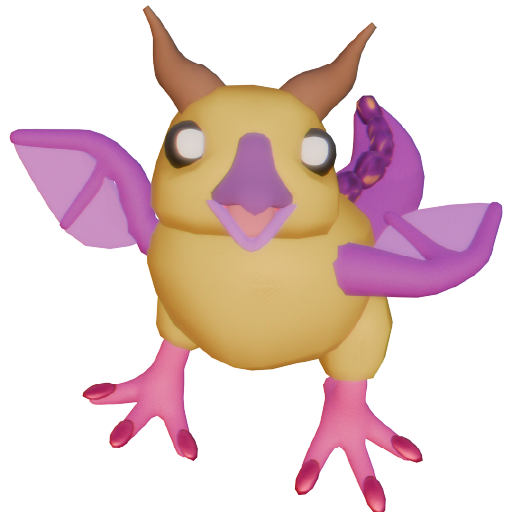
During the GA, the poultry of the mega-farms were left to fend for themselves. The survivors adapted to life in the wild, developing scalier skin in some areas and partially recovering the ability to fly; they also grew two large horns — which biologists clarify are technically teeth.
A basilisk chick on alert.
Scientists named this new species the basilisk, drawing inspiration from an ancient pre-GA myth. There are ongoing attempts to re-domesticate them, as they lay enormous eggs with a yolk-to-white ratio that makes them excellent for baking and pastry. These efforts have shown success at a small scale.
They are omnivores and scavengers.
Some branches of the church have strong and varied feelings about basilisks, viewing them as proof of Roko's presence.
Giant Ravens:
Large ravens with iridescent blue-based plumage. There have been attempts to domesticate them, but they prefer to live in public squares, where they recite poems and songs passed down from generation to generation of ravens in exchange for a little food.
In Mineral de Silicio, they inhabit the plaza and the gardens of the church and the library, seeking to learn songs for their future generations. They are known to travel to other raven communities, so it is normal for a raven to disappear for a time and return with new songs — or to visit a traveling raven passing through.
They nest in hidden spots and do not allow their chicks to be seen until after their first molt. They are monogamous and mate for life; pairs often sing duets.
Green Aura:
A colossal, bald scavenger bird. It performs a fundamental role in the ecosystem: removing large carcasses from the environment through consumption, preventing the spread of disease.
They descend from the turkey vulture, a species still present in some higher-altitude areas less affected by radiation. They are originally from Cuba but spread across all fragments through migration and hybridization with local turkey vultures.
Their plumage shares the same coloration as their ancestors — from cream to black, passing through various shades of brown. The yellow and greenish tones are due to a symbiosis they have developed with a lichen composed of algae and radiotrophic fungi; it is believed that one of the participants in the lichen is the mythical green algae of the Age of Inks, as on humid nights and during rainfall, green auras can be seen glowing faintly.
All attempts to reproduce the lichen that lives in the green aura's plumage have failed.
When they consume irradiated carcasses, the radiation is encapsulated in their feathers, where it is consumed by the lichen; these encapsulations appear as whitish patches.
If they consume more radiation than they can store in their feathers, it accumulates in their bones — especially in the surface of their skull, possibly because it is the part most in contact with the flesh they consume. These accumulations form sarcomas.
Their feathers and bones are used in the nuclear plant, alongside the axolotl pearls. The remains of green auras from other nodes are brought here.
Biter Pigeons:
Larger messenger pigeons; their first size increase was caused by the GA, the second by the artificial selection of their breeders.
Biter pigeons, in addition to inhabiting public squares, perform a vital role in the functioning of the Union: they carry digital mail.
They travel between Union nodes to deliver memory chips. For large files, this option is considerably faster and more reliable than the WAN.
The Matalis consider the care of biter pigeons to be part of human atonement — messenger pigeons were abandoned when other communication methods, such as the telegraph, were established. After the cataclysm, however, we returned to them.
Amphibians and Reptiles.
Axolotls:
Semi-aquatic axolotls the size of a small dog. They are capable of filtering radioactivity from water and storing it in small calcite formations resembling pearls. They are mutants caused by GA contamination, descended from the Achoque de Zacapu. They can reproduce in very few places; one of these is the lake of Mineral de Silicio.
The pearls they produce have multiple uses: they are one of the ingredients in the Cera's hydrating mineral supplements, they are consumables in some X-ray machines, and they are used to calibrate radiation meters.
While they are not technically pets, they are exported to other Union towns to clean natural bodies of water and constructed water containers. Those who maintain these bodies tend to describe the axolotls as the best part of their job.
In the town, they are a vital part of the WSS.
Bubble Alicante:
This species developed in the Bajío region. Like its ancestor, it is diurnal, terrestrial, and non-venomous; it feeds on rodents and small birds and tolerates high doses of radiation. Its scales have earthy colors with a metallic finish that gives off iridescent, bubble-like shimmer. They are proportionally somewhat wider than their ancestors.
When stressed, they inflate two skin pouches on the sides of their face and move them to produce flashes of light; they also make a gurgling sound similar to a bubbling liquid. Their iridescent finish and this curious defense mechanism gave them their name.
They were brought to Mineral de Silicio as natural pest control for the axolotl farm, which at one point suffered from plagues of giant field mice.
While the council permitted the town's farms to import these animals, they are extremely regulated — only juvenile, sterilized specimens may be imported, to avoid repeating the ecological disaster of the sopero scorpion. They are a popular pet among the Loomis, who feel an affinity for them, as both species manipulate light and color.
Arthropods.
Copper Spiders:
During the Green Decade, people gathered copper in warehouses; in the largest warehouse in the Southern Fragment, in northern Brazil, Goliath Tarantulas found shelter.
They began building their nests among the copper and covering their hairy bodies with fragments of it by rubbing against it. Today, it is common for libraries to keep terrariums of these spiders, as their copper-particle webbing is an excellent conductor, widely used in repairing old technology and building new inventions.
They are carnivorous and voracious hunters; they have no venom.
They tend to cohabit with frogs during their nesting periods; the frogs protect the spider's eggs from attacks by other insects and keep the nest moist, while the spider provides protection and food for the frog and its tadpoles.
This symbiosis is used in post-GA art and culture to represent unexpected friendships or alliances; some use it as an icon of radical tenderness — two mothers raising their young together.
Sopero Scorpion:
A giant arthropod, first discovered in the Durango desert. During the Green Decade it was a valuable food source; they reproduce quickly, grow quickly, and eat anything — from grass to carcasses. The Speakers would cut the tip of their tails and carry them alive, as they can go long periods without eating. Survivors brought them to every corner of the continent for their value as a food source.
When the Green Decade ended, a sopero scorpion farm was established in Mineral de Silicio; for some years it was successful, making the town one of the region's main producers. Over time, the food fell out of popularity, partly because other food sources became available. The farm closed and the breeding scorpions were released. They became a plague in the town, threatening endemic wildlife — especially birds, as they eat eggs.
If you encounter one in Mineral de Silicio, the law requires you to kill it; if you are unable to kill it, the sighting must be reported to the SG. Possessing one within town limits may result in fines. In Durango, eating sopero scorpion is still common. The name comes from the fact that if placed over heat in a covered pot, it will become a soup without adding any water. Those who enjoy the dish say the flavor is in the shell.
Mob Ladybug:
After the GA, aphids grew rapidly in size and feeding capacity, reaching up to twenty times the volume of a ladybug. Faced with this, their main predator did not grow to keep pace — instead, it organized.
Mob ladybugs show very few physical changes from their pre-GA ancestors, aside from larger and more conspicuous antennae, which are suspected to be used for communication.
However, they display something previously considered exclusive to colony insects: hierarchy and organization — more similar to that of lions than to that of bees.